















Between 2024 and 2025, the U.S. has seen a rise in artificially generated text, photos and videos. Artificial Intelligence (AI) is a computer system that has been developed to mimic human thinking and creation. By inputting a prompt, AI can gather or analyze large amounts of data for journalists which can then be used to write an article. Supporters of AI say that it benefits journalism by reducing the workload of journalists and helping people with disabilities access news articles easier. However, critics have said that AI can lead to biased or inaccurate articles being published. The discourse surrounding AI has led to many debates and discussions about the extent to which AI should be allowed in journalism.
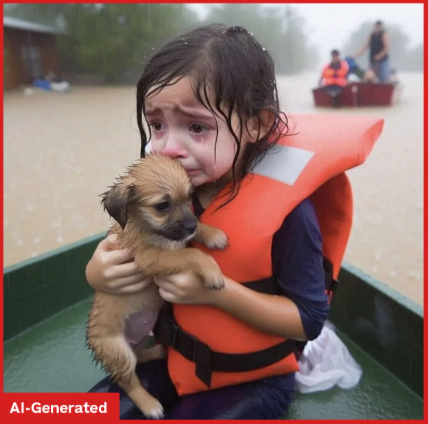
Recently, a study at the University of Maryland found that 9.1% of 186,000 articles from 1,500 newspapers were partially generated by AI (University of Maryland). To understand how people view AI in journalism, multiple students at Tuscarora High School (THS) were interviewed about their opinions. An anonymous THS senior felt like AI was, “[…]not original, and I feel like it takes away the character that the editor or the person that’s writing [has].” Similarly, senior Lily Lucia described, “I’m fine with spellcheck because that makes sense since it’s an AI program. If you’re using ChatGPT, you’re just kind of making up an article and there’s no real person or proof behind it. I’d rather read something from a person than a computer.” On the topic of AI fabricating responses, the European Broadcasting Union (EBU) found that 45% of AI-generated news contains severe accuracy errors and 81% contains at least one error. Furthermore, images and videos created by AI have been used to spread false information. During Hurricane Helene in 2024, a photograph of a young, terrified girl holding a puppy was posted online. Many Republican officials, such as Sen. Mike Lee and Republican National Committee member Amy Kremer, used this image to criticize Democrats for how they were handling the hurricane. Although this image was proven to be AI, millions of people had still seen this image and believed it to be real evidence for how Democrats were failing the public. According to the University of Waterloo, a 2022 study showed that only 61% of participants were able to correctly identify AI-images. If AI writing or images are used in journalism without any fact-checking by humans, misinformation or bias could easily be spread.
On the other hand, despite the risk of misinformation that comes with using AI, supporters have brought up how AI can help journalists with data analysis and collection. Due to how AI is a program, it’s capable of looking through large quantities of data very quickly. According to Model Evaluation & Threat Research (METR), the most modern AI can complete a task that would take a human two hours and 42 minutes to do in seconds with a 71.6% success rate. As long as humans fact check the AI’s accuracy, the AI can sort through information to find the best ones to use in an article for journalists. Another benefit AI has is through making articles more accessible to people with disabilities. One anonymous THS English teacher, although she’s against AI in writing, said that, “I do like when things are brought into any realm of accessibility like text-to-speech or the opposite for different people.” Through its text-to-speech function, AI can read written text out to people who are blind. Oppositely, AI can take a video and create a written transcript for it. This is helpful for allowing people who are hard of hearing to gain information from a newscast or video interview. The English teacher described in regards to the transcripts, “I found this application where you put in a Youtube video and it’ll create a transcript. It was very convenient, especially when some kids had trouble keeping track of the video, to give them the transcript. But I did read over it myself while watching the video to make sure it matched.” While this teacher agreed that AI has some benefits, she stressed that humans should always do a final check to ensure accuracy.
Personally, I believe that while AI might have some time-saving benefits in journalism, it should only be used for making articles more accessible. According to the University of Maryland, only five out of 100 articles using AI disclosed their usage. When AI is used in journalism, the accuracy and truthfulness of the news reported goes into question. All three interviewees and myself agreed AI should also be disclosed somewhere in the article. Not only that, but AI has shown to have an enormous environmental impact. During the interview with Lucia, she described how, “AI also has bad impacts on the environment because the power plants used to power AI have severe greenhouse gases that get emitted.” The United Nations Environmental Programme (UNEP) found that a two kilogram computer to run an AI program required 800 kilograms (800,000 grams) of raw materials. For reference, a paper clip weighs about one gram. Furthermore, UNEP found that one request through ChatGPT, a popular AI program, takes 10 times more energy than one Google search.
In essence, AI must be used responsibly to best benefit the news and the planet’s environment. As the anonymous THS senior put it best, “it’s a good tool, but it’s how you use [AI] that depends on if you ruin it for everybody.” At most, AI should be used to help people with disabilities access news articles. Even though AI could be helpful in saving time writing articles, it comes with too many social and environmental drawbacks for it to be used anymore than the bare minimum.
Report: AI Use in Newspapers Is Widespread, Uneven and Rarely Disclosed
AI-generated images have become a new form of propaganda this election season
AI has an environmental problem. Here’s what the world can do about that.
Research shows survey participants duped by AI-generated images nearly 40% of the time